


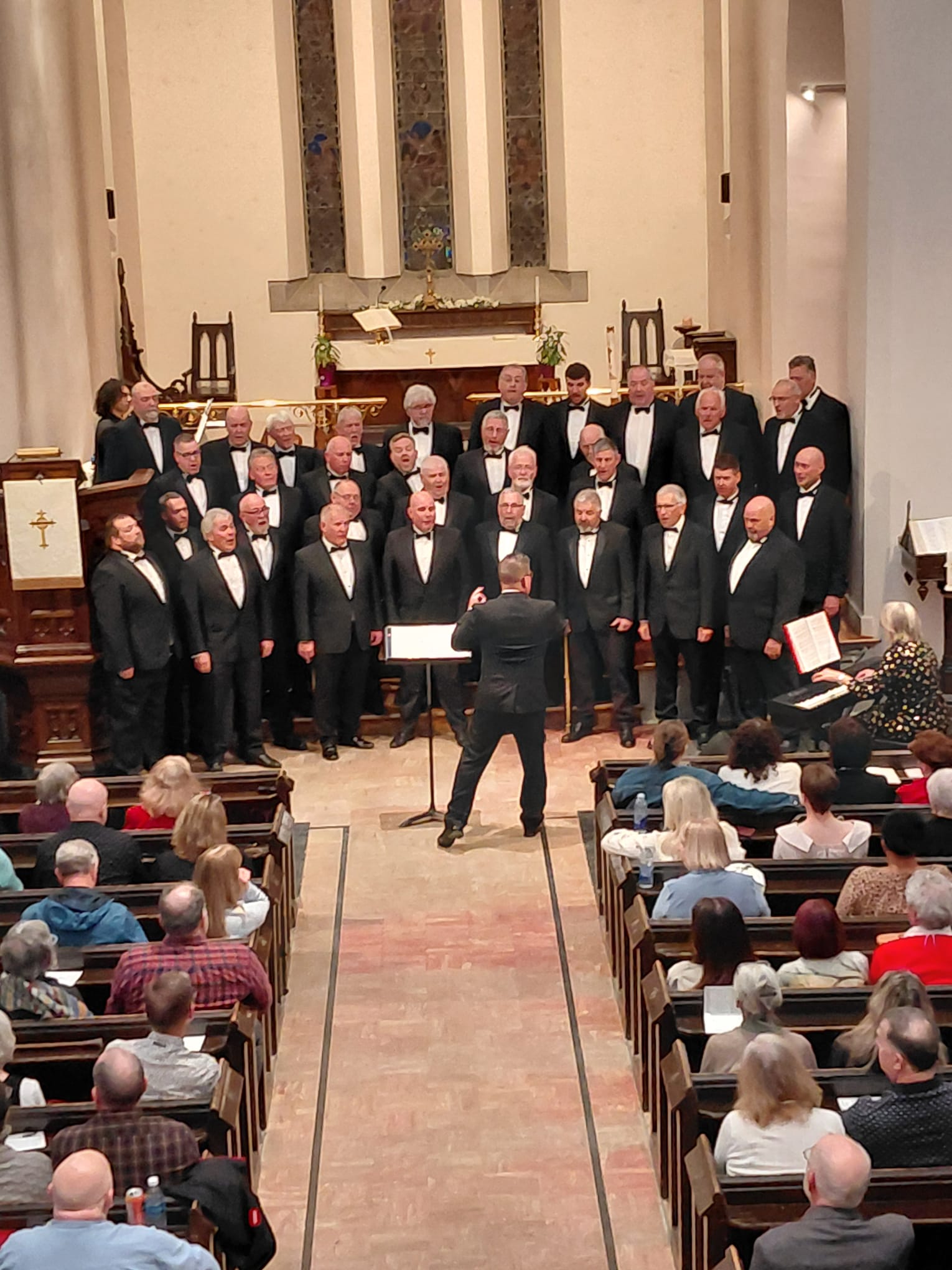
 On Saturday 11 July 2026, Holy Trinity Church on Mostyn Street will host a special performance by Cantorion Gogledd Cymru, in aid of one of Llandudno’s most significant heritage causes of recent years: the appeal to install a permanent memorial window remembering the eight Llandudno men who died in the Wormhout Massacre of 1940, and all those who lost their lives alongside them.
Cantorion Gogledd Cymru
Holy Trinity Church, Llandudno
Saturday 11 July 2026, 7.30pm
Tickets: £15, in aid of the Wormhout Memorial Window Appeal
Musical Director: Aled Edwards
Accompanist: Ruth Lloyd Owen
Organist: John Liddon-Few
Organised by: The Conwy Region of North Wales Freemasons
Tickets: Jason Winter, 07867 804929, [email protected]
Full details: https://www.cantoriongogleddcymru.co.uk/
Every ticket sold goes towards a memorial that, once complete, will be the only one of its kind in Wales. To understand why that matters — and why this concert is worth attending for more than the music alone — it helps to know the story the window will tell.
A Bond Forged in 1940
The story goes back to May 1940 and the desperate retreat to Dunkirk. As German forces pushed through northern France and Belgium, the British Expeditionary Force and other Allied troops were driven back towards the Channel, with units ordered to hold defensive positions so others could escape. Wormhout lay in the path of that retreat, south of Dunkirk, where British soldiers fought to slow the German advance.
Among them were men of the 69th Medium Regiment, Royal Artillery — gunners who had trained at the Drill Hall on Argyll Road in Llandudno and become D Troop of 242 Battery. These were not distant, anonymous soldiers. They were local men, with families, jobs and addresses in the town.
On 28 May 1940, D Troop’s convoy, trying to reach Dunkirk, diverted towards Wormhout believing the town was still held by British forces. It came under fire. Some men were killed outright; others were taken prisoner by soldiers of the Leibstandarte SS Adolf Hitler. Survivors were marched towards a barn near Esquelbecq — the wounded who could not keep pace were killed along the way — and at the barn, grenades were thrown in and those still living were shot or machine-gunned. Up to 100 British soldiers were held there; around 80 did not survive. It has become known as the Wormhout Massacre.
It remains difficult, even now, to say precisely who died in the fighting, who died on the march, and who was murdered in the barn. That uncertainty is part of the horror of the story — but the fate of the Llandudno men is clear enough for remembrance. Eight gunners from the town’s D Troop, 242 Battery, are named among those lost at Wormhout:
- Ronald Ashley
- Vincent Kevin Barrie
- Eric Stanley Beeton
- Harold Bowen
- John Coleman
- Robert Edwards
- George Morris
- Frank George “Lally” Thompson
Not every man died in the barn itself, but all eight are remembered together as the Llandudno men whose fate was bound up with the events of that day. One survivor, Richard Parry of Lloyd Street, lived to give post-war testimony — a rare first-hand account that has helped preserve the human reality of what happened, in a story that could otherwise so easily have been lost to the chaos of war and scattered across military records, cemeteries and fading family memory.
Wormhout Way and the Town Twinning
Many people in Llandudno know the name Wormhout without knowing this story. They may have driven along Wormhout Way, the town’s main route in and out, or noticed references to the twinning around the town, without ever asking why.
Llandudno Town Council explains that the answer lies in 1940 and the retreat to Dunkirk. The town was officially twinned with Wormhout in 1988 specifically so that the events of that day would not be forgotten. It remains an active relationship: the council supports cultural exchanges between the two towns, and each July a group travels to Wormhout to coincide with its carnival and music festival, staying with French host families, learning the town’s history, and taking part in a service at the massacre memorial site to pay tribute to those who died.
The massacre is already remembered in France. La Plaine au Bois marks the site connected with the barn, and the wider area around Wormhout and Esquelbecq forms part of the remembrance landscape of the Dunkirk retreat. The Commonwealth War Graves Commission records that Esquelbecq Military Cemetery holds 47 Second World War Commonwealth burials from the German advance and the BEF’s withdrawal that May, while Wormhoudt Communal Cemetery contains more than 140 Second World War graves, over 30 of them unidentified.
For anyone from Llandudno able to travel to northern France, these places make the story real. But not everyone can make that journey — which is why attention has now turned to creating a place of remembrance closer to home, and why this concert’s purpose runs deeper than a single evening’s entertainment.
The Wormhout Memorial Window Appeal
Bro Tudno — the Church in Wales Ministry Area of Llandudno, previously known as the Parish of Llandudno, and the local church body serving Holy Trinity Church in the town centre and St Tudno’s on the Great Orme — is leading the appeal to install a permanent memorial window at Holy Trinity Church, the very building hosting this concert.
The name Bro Tudno reflects the town’s own origins: Saint Tudno is the saint from whom Llandudno takes its name, and bro is the Welsh word for an area or local community. It is a fitting body to lead this appeal, given how closely the story is tied to the town’s identity.
As far as Bro Tudno is aware, there is no memorial in England or Wales dedicated specifically to those who died in the Wormhout Massacre, and no existing memorial in Llandudno itself for the eight local men who lost their lives there. That absence is part of what makes this appeal significant. It is local, in that it remembers named men from the town. It is national, in that it may create the only memorial of its kind in Wales. And it is European, in that it draws together Llandudno, Wormhout, Dunkirk and the wider history of war and reconciliation across the Channel.
The setting is significant too. Holy Trinity’s Memorial Chapel was originally built to commemorate the fallen of the First World War, and 2024 marked the 100th anniversary of its dedication. Bro Tudno says the idea for a new Wormhout window grew directly out of that anniversary, and the wish to extend the chapel’s remembrance to the Llandudno men — and the wider group of soldiers — who died at Wormhout in the Second World War.
The Proposed Design
No final design has yet been approved — Bro Tudno confirms the artwork itself has still to be drawn — but the direction is already clear.
The Memorial Chapel’s north wall holds six window openings. Five already contain stained glass depicting saints: St Tudno, St George, St David, St Cadwaladr and St Francis of Assisi. The sixth, at the far left, currently holds plain glass, and it is this opening that has been proposed for the new memorial. Because church regulations require any new stained glass to sit in keeping with its neighbours, the Wormhout window will need to work within that existing saint-window scheme.
The likely subject reflects that constraint in a striking way: an image of St Winnoc, together with the barn where the massacre took place. St Winnoc is associated with Wormhout itself — Bro Tudno describes him as a seventh-century Bishop of Flanders and Abbot of Wormhout, reputedly of Welsh origin. If this direction is followed, the window would draw together three threads in a single image: St Winnoc, linking Wales and Wormhout across the centuries; the barn, representing the historical reality of what happened there; and the Memorial Chapel itself, bringing that remembrance into the civic and spiritual heart of Llandudno.
It would not simply decorate the chapel. It would tell the story — and it is projects like this, funded pound by pound through events such as this concert, that turn a proposal on paper into glass in a wall.
A Church Already Woven into the Town
Holy Trinity Church stands on Mostyn Street, in the centre of Llandudno. The National Churches Trust describes it as a fine Victorian church with notable stained glass and carvings, built to serve the growing town as it developed beyond the older parish church of St Tudno on the Great Orme.
It is not an anonymous setting. Holy Trinity is already one of the town’s most recognisable buildings, its windows, carvings and memorials forming part of Llandudno’s visible heritage. Attending the concert on 11 July means sitting in that same chapel, beside the very window opening the appeal hopes to fill — a rare chance to experience the space the memorial will occupy before the work begins.
Why It Matters Now
Names on a page matter. Military records matter. War cemeteries matter. But a memorial in the town itself gives a story like this a local centre of gravity that archives alone cannot provide.
It says these men belonged here. It says Llandudno remembers. And it says that this is not only a French battlefield story, or a Dunkirk story — it is a Llandudno story too, one that runs from the Drill Hall on Argyll Road to a barn near Esquelbecq, and back again to a quiet window in a Mostyn Street church.
That is what makes the concert on 11 July more than a pleasant evening of choral music. Cantorion Gogledd Cymru’s performance, organised by the Conwy Region of North Wales Freemasons, gives everyone in Llandudno a direct and simple way to help finish a story that began 86 years ago — by taking a seat, and buying a ticket.
Tickets are £15 and available from Jason Winter on 07867 804929 or [email protected]. All proceeds support the Wormhout Memorial Window Appeal at Holy Trinity Church. Full details: https://www.cantoriongogleddcymru.co.uk/
