Who Alice Liddell Was
Alice Pleasance Liddell was born on 4 May 1852 in Oxford. Her father was Henry Liddell, one of the most prominent classical scholars in Victorian England and Dean of Christ Church College, Oxford — a role that placed the family at the heart of Oxford academic and social life. The Liddells had several children, and Alice was the third daughter. She grew up in the Deanery at Christ Church, surrounded by the academic and ecclesiastical world that shaped Victorian upper-middle-class life.
She would not have been a famous figure in history at all had it not been for a family friendship with Charles Lutwidge Dodgson — a mathematics lecturer at Christ Church who published under the name Lewis Carroll. Dodgson was a frequent visitor to the Deanery and became something of a companion to the Liddell children, taking them on expeditions and telling them stories. It was from this friendship that Alice in Wonderland grew.
It is worth being clear about what that means. Alice Liddell was not the character in the book. She was the real child whose personality, questions and presence inspired the character, and whose name — and in the acrostic epilogue to Through the Looking-Glass, whose full name — is embedded in the work. Carroll was precise enough about this that the epilogue poem to Through the Looking-Glass (1871) spells out ALICE PLEASANCE LIDDELL in acrostic: the first letter of each line.
The Oxford Boat Trip: 4 July 1862
The origin of Alice's Adventures in Wonderland is one of the most documented moments in English literary history. On the afternoon of 4 July 1862, Carroll took Alice, her sisters Lorina and Edith, and a colleague on a rowing trip on the River Isis in Oxford. To entertain the children, Carroll began telling a story about a girl called Alice who fell down a rabbit hole into an underground world full of strange creatures and stranger logic.
Carroll recorded the trip in his diary. Alice apparently loved the story and asked him to write it down. He did — producing a handwritten manuscript with his own illustrations, which he titled "Alice's Adventures Under Ground" and presented to Alice as a Christmas gift in 1864. He then expanded and revised it for publication, and "Alice's Adventures in Wonderland" — illustrated this time by the professional artist John Tenniel — was published by Macmillan in 1865.
This Oxford origin story is the confirmed, documented version of how the book came to be. Llandudno's claim is not that the book was written here — it is that Alice herself was here, and that the connection between Carroll and the Liddell family during the Llandudno years may have contributed something to the ongoing relationship from which the books emerged.
Llandudno: 1861 to 1873
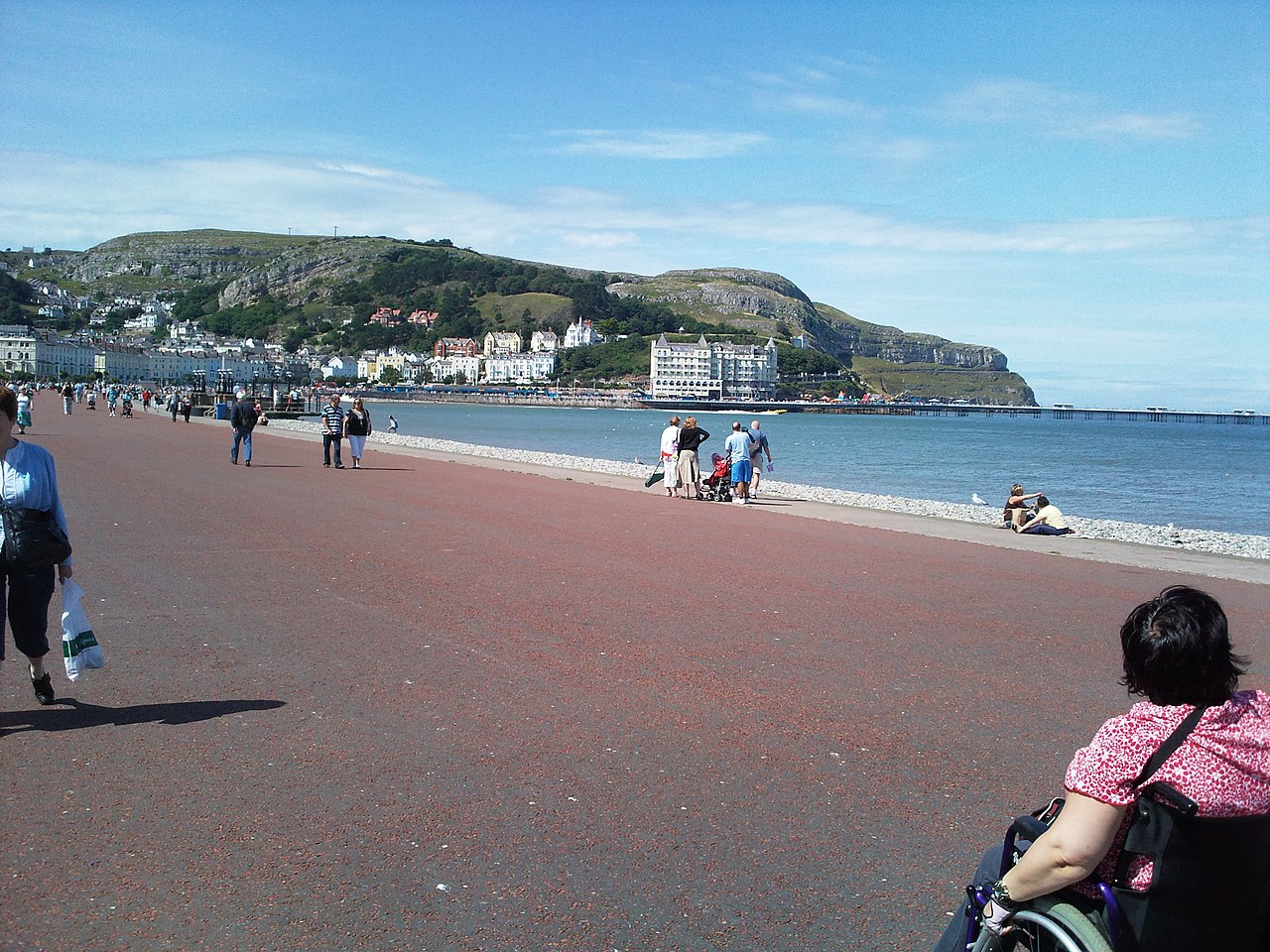
Alice first came to Llandudno at Easter 1861, aged eight, when her family stayed at Tudno Villa on North Parade. The following year they stayed at the St George's Hotel on West Shore, and Dean Liddell commissioned a mock Gothic house to be built on that shore. Named Penmorfa, it was completed in 1862 and used by the family for Easter, summer and Christmas holidays for the next eleven years.
For Alice, these were the years from age eight to nineteen. The West Shore environment — the bay, the sand hills, the Great Orme rising behind, the zigzag paths above the house — was as much a part of her childhood as Oxford. Distinguished visitors came to Penmorfa: William Gladstone and the poet Matthew Arnold were among those who stayed or visited. The house was a lively, well-connected Victorian household transported to the Welsh coast.
In 1873, with Alice aged twenty-one, the family sold Penmorfa. It was the end of what had been an eleven-year chapter. Alice would not return to Llandudno until the 1930s invited her to do so — and by then she was too old to make the journey.
Alice's Own Words About Penmorfa
In 1933, when Alice Hargreaves (as she had become) was invited to attend the unveiling of the White Rabbit statue at West Shore, she was eighty-one years old and too frail to travel from her home in Hampshire. She sent a letter to the ceremony. In it she wrote:
"I still have the happiest memories of Penmorfa, as my father's house at Llandudno was called then, and of the rambles over the Great Orme's Head and among the Llandudno sand hills. I wish I could come personally in gratitude for those joyous days, and for the days spent with Mr Dodgson."
The phrase "joyous days" carries real weight from a woman of eighty-one writing about experiences sixty years past. The specific mention of the Great Orme and the sand hills suggests these were vivid memories, not vague sentiment. And the coupling of Llandudno days with "the days spent with Mr Dodgson" has been taken by historians as implying that Carroll was present at Llandudno on at least one occasion — although Alice never stated this explicitly, and her phrasing is ambiguous enough that certainty is not possible.
Later Life: Marriage, Loss, and the Manuscript Sale
In 1880 Alice Liddell married Reginald Hargreaves, a Hampshire cricketer and gentleman of some standing. They lived at Cuffnells, a substantial estate near Lyndhurst in the New Forest. They had three sons: Alan, Leopold, and Caryl.
The First World War was devastating for the family. Alan and Leopold Hargreaves were both killed in action. Alice lost two of her three sons to the war. Reginald Hargreaves died in 1926, and without his income, maintaining Cuffnells became financially impossible. Alice was in her mid-seventies and facing the need to sell.
In April 1928, she sold the original handwritten manuscript — the "Alice's Adventures Under Ground" that Carroll had given her as a Christmas gift in 1864, the physical document that began everything — at Sotheby's in London. She was seventy-five years old. The manuscript fetched £15,400, equivalent to approximately £800,000 in 2025 values. She described the sale as one of the most painful things she had ever done. The manuscript eventually made its way to the United States, where it became a symbol of Anglo-American cultural relations; in 1946 it was returned to Britain by a group of American donors and is now held at the British Library.
The Columbia Honorary Doctorate and the 1933 Letter
In 1932, aged eighty, Alice travelled to the United States to receive an honorary doctorate from Columbia University in New York, as part of the centennial celebrations of Carroll's birth. It was a recognition of the role she had played in inspiring one of the most celebrated works of English literature — a recognition that came very late in her life but was clearly meaningful to her.
The following year, 1933, Llandudno invited her to the unveiling of the White Rabbit statue at West Shore. She was eighty-one and unable to attend, but she sent the letter quoted above. Asked when Carroll had visited Llandudno, she replied that it could not have been before 1862, since the family was not there before then — a statement that historians have taken as implying she believed a visit did occur, without her stating it directly. The combination of the 1932 voyage to America and the 1933 letter shows a woman who, in her final years, was engaging actively with the Carroll legacy rather than retreating from it.
Death and the Acrostic Epilogue
Alice Hargreaves died on 16 November 1934, at the age of eighty-two. Her ashes were interred at St Michael and All Angels church in Lyndhurst, Hampshire, near the Cuffnells estate where she had lived.
Carroll had embedded her full name in his work long before her death. The epilogue poem of Through the Looking-Glass (1871) — a tender, elegiac piece about the passage of childhood — is an acrostic: the first letter of each line spells out ALICE PLEASANCE LIDDELL. It is Carroll's most direct acknowledgement in print of the real person behind the fictional character, and it suggests that the relationship between the man and the family was not simply that of a storyteller and his audience.
Alice Liddell lived long enough to see Alice in Wonderland become a global cultural phenomenon, to sell the document that began it, to receive academic recognition for her role in it, and to write warmly about the seaside summers where part of her story with Carroll unfolded. Whether the Llandudno connection was central or peripheral to the creation of the books, it was clearly central to her own memories.
 Day trips