The Poem in Through the Looking-Glass
"The Walrus and the Carpenter" is one of Lewis Carroll's best-known poems, and one of the darker pieces in his work. It appears in Through the Looking-Glass, and What Alice Found There, published in December 1871, where it is recited by Tweedledum and Tweedledee to Alice. The poem tells the story of a Walrus and a Carpenter who invite a group of young oysters for a walk along a beach, then proceed to eat them all — a tale that Alice finds troubling, and which the twins interpret with a pragmatic unconcern that reflects Carroll's characteristic interest in the gap between surface politeness and underlying reality.
The poem opens:
"The sun was shining on the sea,
Shining with all his might:
He did his very best to make
The billows smooth and bright —
And this was odd, because it was
The middle of the night."
The setting is a beach, the mood is dreamlike and slightly sinister, and the visual details — the shining sea, the smooth billows, the rocks and sand — have the quality of a real beach remembered and then distorted by dream logic. Carroll published Through the Looking-Glass nine years after the 4 July 1862 boat trip that generated Alice's Adventures in Wonderland, and it drew on the same stock of imagination and relationships.
The West Shore Rocks
In West Shore bay at Llandudno, two rocks stand in the water within sight of where Penmorfa — the Liddell family's holiday home — once stood. These rocks are known locally as the Walrus and the Carpenter. They are also sometimes called "the Two Sisters," a name that may predate the Carroll association or may simply be an alternative that has persisted alongside it.
The rocks behave as the poem's beach setting would suggest: they are visible at low tide, when the bay's gentle slope exposes them and they can be seen from the shore, and they are submerged at high tide, disappearing beneath the water. Standing on West Shore at low tide, looking out toward the estuary, they are a tangible feature of the bay — not dramatic, not particularly distinctive in themselves, but there.
The connection to the poem is plausible. The Liddell family used Penmorfa for eleven years, from 1862 to 1873. If Carroll visited — and the evidence, though not conclusive, suggests he probably did — he would have walked this shore and looked at these rocks. The poem was written in 1871, during the years when the Liddells were still at Penmorfa. A beach with tide-covered rocks, seen from a house overlooking the sea, is exactly the kind of real landscape that could be absorbed and transformed by Carroll's imagination.
How Strong is the Tradition?
The honest answer is: it is a well-established local tradition, but it has not been verified against Victorian documentary evidence. No 19th-century source has been identified that names these specific rocks after the Walrus and Carpenter, or that records Carroll pointing at them and declaring them to be the inspiration for the poem. The earliest known written references to the rocks by these names appear to be from the 20th century.
This does not make the connection false — absence of evidence is not evidence of absence, and Victorian labelling of landscape features was not always written down. Oral traditions about local geology and geography could survive for decades before being committed to print. But it means that the Walrus and Carpenter rocks occupy the same category as much of Llandudno's Carroll connection: plausible, circumstantially well-supported, but not yet proven by documentary evidence.
What would strengthen the tradition is a systematic search of Victorian-era Llandudno guidebooks and local newspaper descriptions of West Shore, to see whether the rocks were named in print during the period when the Liddells were at Penmorfa. The British Newspaper Archive and the collections of Conwy Archive Service are the most likely sources. This kind of specific historical research has not, to date, been published in accessible form.
West Shore and the Beach Setting of the Poem
Whatever the specific evidence for the rocks, the broader connection between West Shore and "The Walrus and the Carpenter" is at least coherent. The poem is set on a beach with a strong tidal character — rocks visible at one time and submerged at another, a sweep of sand, a sea that catches sunlight. West Shore at Llandudno has all of these features. The Conwy estuary gives the water a particular quality of light and stillness that distinguishes West Shore from the more exposed North Shore, and the Great Orme provides the kind of dramatic backdrop that might inspire the "rocky shore" mentioned later in the poem.
The Liddell family's specific use of West Shore — as opposed to the main promenade beach — is also relevant. Penmorfa was on West Shore. The sand hills Alice mentioned in her 1933 letter were the dunes behind West Shore. The zigzag paths she and her family walked were on the Great Orme, visible from West Shore. This was the shore they knew, not North Shore's grander Victorian parade. If any Llandudno landscape entered the books, it would most naturally be the quieter, more intimate character of the western bay.
Seeing the Rocks Today
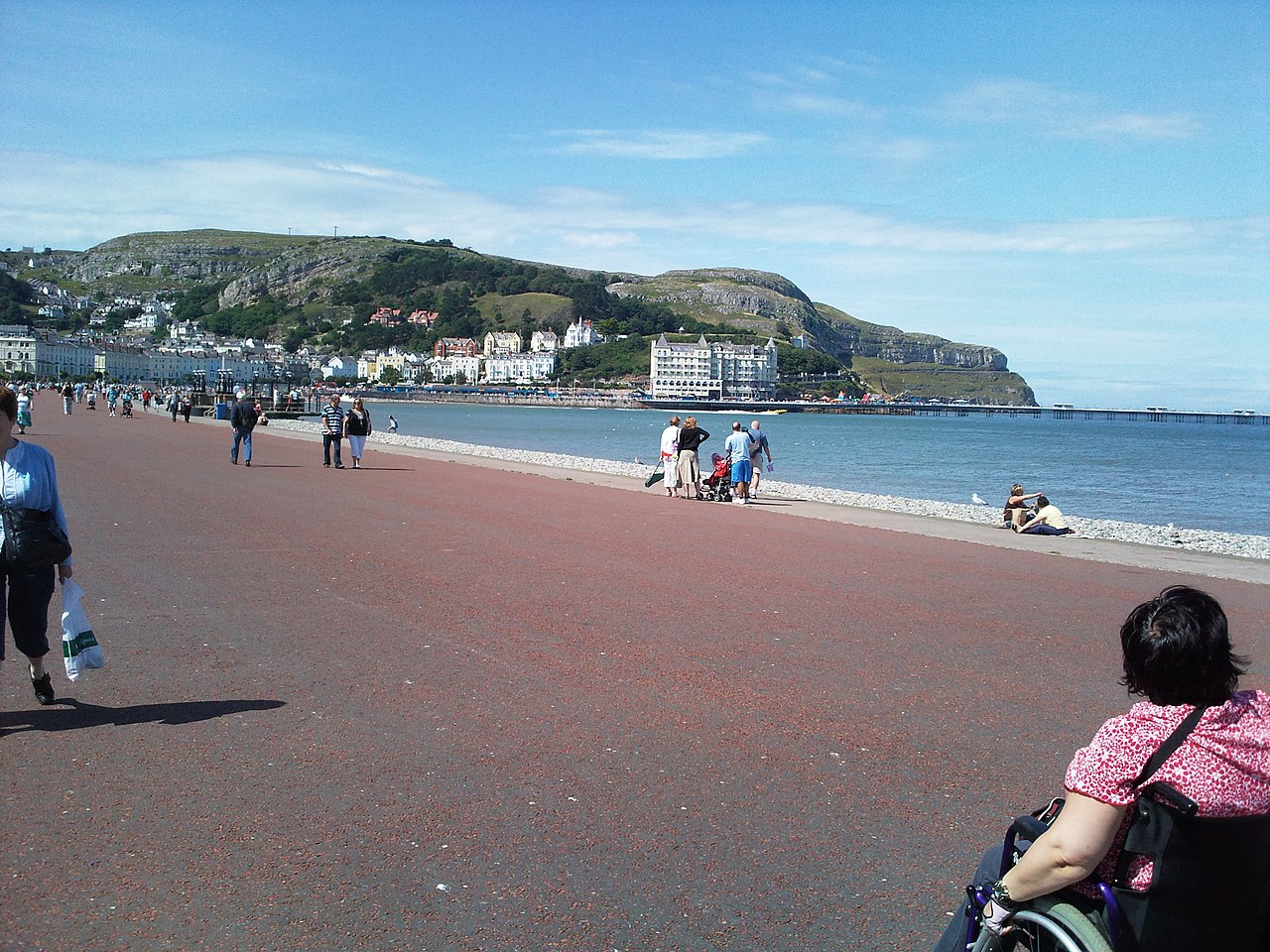
The rocks known as the Walrus and the Carpenter are visible from West Shore at low tide. The best time to see them is on a falling or low tide, when the bay's gentle gradient exposes the rocks clearly. At high tide they disappear. The White Rabbit statue stands nearby, and the general area of West Shore where the rocks can be seen is the same ground where Penmorfa once stood.
There is no formal viewing point or signage specifically for the rocks. They are simply there, in the bay, as they have been for as long as anyone has looked. Whether Carroll saw them and was moved to write a poem about a beach with tide-covered rocks, or whether the local tradition attached the Carroll poem to the rocks after the book made them famous, is one of the open questions in Llandudno's Alice story. Either way, they are an interesting thing to look for when you are standing on West Shore — the kind of detail that rewards knowing the story before you arrive.
 Day trips