The Finding Alice Trail
Llandudno's Finding Alice trail is a self-guided walking route covering 34 points of interest connected to the town's Alice in Wonderland story. The trail takes in the wooden character statues positioned around the town, the marble White Rabbit statue at West Shore, the site where Penmorfa — the Liddell family's holiday home — once stood, and a range of locations that contextualise Llandudno's genuine and well-documented connection to Alice Liddell.
The trail is free, self-guided and accessible year-round. It can be walked in its entirety in a few hours, or individual highlights can be visited independently. No booking is required. The route can be walked in any order, though the suggested route below starts at the railway station (where Alice herself would have arrived) and ends at West Shore (where her story in Llandudno is most vividly present).
Understanding the trail is enhanced by knowing who Alice Liddell actually was — not just the character in the book, but the real girl who spent eleven summers here from 1861 to 1873. The main Alice in Llandudno page provides the full background, and the individual pages on Alice Liddell, Penmorfa, and Lewis Carroll's possible visit give the detail that makes the trail genuinely illuminating rather than just a sequence of sculptures.
The Character Statues: Where to Find Them
Five large wooden carved character statues are positioned around Llandudno as part of the Finding Alice trail. Each is substantial enough to be unmissable once you know roughly where to look. They are:
- Alice — outside Llandudno railway station. This is the natural starting point for the trail: Alice stands at the place where any visitor arriving by train would first set foot in Llandudno, just as the real Alice Liddell would have arrived in the Victorian era.
- Queen of Hearts — near the Italian restaurant on the promenade. The Queen's natural domain is the grand Victorian promenade, and she keeps good company with the North Shore hotels behind her.
- The Hatter — on the promenade, gazing up at the Great Orme. The Hatter's pose — looking upward at the headland — is one of the more evocative choices in the set. The Great Orme that the Hatter contemplates is the same headland Alice Liddell described rambling over in her 1933 letter.
- Cheshire Cat — at West Shore, close to the former site of Penmorfa. The Cheshire Cat's position near where the Liddell family house once stood gives it particular resonance. The Cat that disappears leaving only its smile is, in a sense, an apt symbol for Penmorfa itself — demolished in 2008 and now present only as a memory and an undeveloped site.
- Tweedledee and Tweedledum — in Haulfre Gardens. The twin brothers occupy the gardens together, appropriately paired.
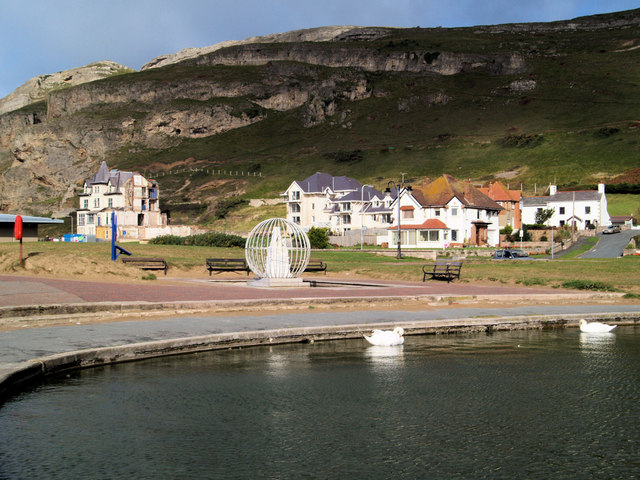
The White Rabbit Statue at West Shore
The marble White Rabbit statue at West Shore is the oldest and most historically significant of Llandudno's Alice memorials. Sculpted by Frederick Forrester, a local stonemason, it was unveiled on West Shore in 1933 by former Prime Minister David Lloyd George. Alice Liddell — by then eighty-one years old and living in Hampshire as Alice Hargreaves — was too frail to attend the ceremony. She sent a letter that was read at the unveiling, in which she described her memories of Penmorfa and of "joyous days" at Llandudno.
The statue was vandalised repeatedly over the decades and eventually enclosed in a steel cage. In 2012 sculptor Nick Elphick carried out a significant restoration. In 2015 the statue was moved from its original position by the model boating lake to its current location, which offers better visibility. The plaque on the statue makes claims about Carroll's inspiration that go beyond the documented evidence — this is discussed in detail on the White Rabbit statue page — but the statue itself is a charming and historically grounded piece of public sculpture.
The Site of Penmorfa
One of the most important stops on the Alice trail has no building to visit. The site where Penmorfa once stood — the mock Gothic holiday home that Dean Henry Liddell built for his family in 1862, and in which Alice Liddell spent eleven summers — is an undeveloped plot at West Shore, in the postcode area LL30 2QY. Penmorfa was demolished by Anwyl in 2008 despite a significant local campaign to save it. The site has remained undeveloped since.
Standing where Penmorfa once stood, you look out across the West Shore bay toward the Conwy estuary. From here, at low tide, you can see the two rocks known locally as the Walrus and the Carpenter — after the characters in Carroll's poem in Through the Looking-Glass. The Walrus and Carpenter page explains the tradition and how much evidence supports it. The Great Orme rises behind you: this was the "Great Orme's Head" Alice mentioned in her 1933 letter, the headland she rambled over as a child and remembered vividly sixty years later.
Read the full history of Penmorfa before you visit this spot: knowing the building's life — from Victorian holiday home to officers' mess, PG Tips set, and ultimately rubble — makes standing on the empty site considerably more affecting.
Suggested Walking Route
The following route takes in all the major Alice landmarks in a logical order, moving from the railway station through the town to West Shore. It is broadly linear, with a detour to Haulfre Gardens for Tweedledee and Tweedledum. Total walking distance is moderate; most sections are flat, though the detour to Haulfre Gardens involves a gentle climb.
- Llandudno railway station — begin with Alice, who stands outside the station. This is where any Victorian visitor arrived, and where the real Alice Liddell would have arrived from Oxford. Allow time here before continuing into town.
- The Promenade (North Shore) — walk down to the promenade along Mostyn Street and continue along the seafront. Find the Queen of Hearts near the promenade's Italian restaurant and the Hatter gazing at the Great Orme. The Victorian architecture of North Shore's hotel frontage is the backdrop here.
- The Pier — Llandudno's Victorian pier, the longest in Wales at 2,295 feet, is worth a detour from the promenade. It is not part of the Alice trail specifically, but the Pier Pavilion and the view from the pier head reward the walk.
- Haulfre Gardens — take a bus or walk to Haulfre Gardens (the gardens lie above the town on the Great Orme approach road) to find Tweedledee and Tweedledum. The gardens offer good views over the bay.
- West Shore — cross the promontory from North Shore to West Shore. The quieter, more sheltered western bay is where the Alice story is most directly present. Find the Cheshire Cat near the former Penmorfa site, visit the site itself (LL30 2QY), look out for the Walrus and Carpenter rocks in the bay (best seen at low tide), and end at the White Rabbit statue.
Practical Information
Cost: Free throughout. There are no admission charges for any element of the Finding Alice trail.
Accessibility: The promenade section and West Shore are flat and accessible. Haulfre Gardens involves a gentle uphill approach. The trail is pushchair-friendly along the main route; some detours involve steps or uneven ground.
When to visit: The trail is accessible year-round. Summer offers the best chance of seeing the rocks at West Shore clearly; they are tidal and best viewed on a falling or low tide. The character statues are all outdoors and visible in all weathers.
Getting there: Llandudno has direct rail services from Chester (approximately 1 hour) and Manchester (approximately 2 hours). The railway station is the natural starting point for the trail. Parking is available at West Shore and on the North Shore promenade.
More context: The trail is most rewarding if you arrive knowing the real story. Start with the main Alice in Llandudno hub page, which links to the full accounts of Alice Liddell's life, Penmorfa's history, and the question of whether Carroll visited.
 Day trips