Llandudno's Claim: Alice's Seaside Home
Of all the places associated with Alice in Wonderland, Llandudno makes the most specific and best-documented claim: not that Lewis Carroll wrote the book here, but that Alice herself lived here. Alice Pleasance Liddell — the Oxford girl who was the direct inspiration for Carroll's stories — spent eleven years of childhood and adolescence at West Shore, beginning with her family's first visit at Easter 1861 and continuing until 1873. These were not occasional day trips. The Liddell family built a house here, named Penmorfa, and used it for Easter, summer and Christmas holidays across more than a decade.
For a girl who first visited at the age of eight and last came at twenty-one, West Shore was a formative landscape. The Great Orme rising behind the bay, the sand hills between the two shores, the view across the Conwy estuary — these were the scenes of what Alice herself, writing in her eighties, described as "joyous days." The White Rabbit statue at West Shore, the wooden character statues around the town, and the 34-point Finding Alice trail are all part of how Llandudno commemorates a connection that is, by the standards of literary tourism, genuinely well-founded.
The Liddell Visits: 1861 to 1873
The family connection began at Easter 1861, when Dean Henry Liddell — Alice's father, then Dean of Christ Church College, Oxford — brought his family to Llandudno for the first time. They stayed at Tudno Villa, a lodging house on North Parade, in what is now the site of the St Tudno Hotel. They clearly liked what they found, because they returned the following year. In 1862 they stayed at the St George's Hotel on West Shore, and Dean Liddell commissioned a mock Gothic house to be built on that same shore. Completed in 1862 and named Penmorfa, it became the family's holiday home for the next eleven years.
The house was substantial enough to attract distinguished guests. William Gladstone — Prime Minister four times over, who represented the Flint Boroughs constituency nearby — visited Penmorfa, as did the poet and critic Matthew Arnold. The house was also the subject of at least one photograph in the album Lewis Carroll gave to Alice: the photograph shows a man in an artistic pose outside Penmorfa, believed with strong probability to be Carroll himself, though this cannot be confirmed with the certainty that his missing diaries would have provided.
In 1873 the Liddell family sold Penmorfa. By then Alice was twenty-one. The house passed through several owners, became the Gogarth Abbey Hotel, served as an officers' mess during the Second World War, and later — perhaps most incongruously — hosted the PG Tips chimpanzee television advertisements in the 1970s. It was demolished in 2008 despite a significant local campaign to save it. The site at West Shore, postcode area LL30 2QY, remains undeveloped.
Alice's Own Words
In 1933, when Alice Liddell — by then Alice Hargreaves, aged eighty-one — was invited to attend the unveiling of the White Rabbit statue at West Shore, she was too frail to travel from her home in Hampshire. She sent a letter instead. In it she wrote: "I still have the happiest memories of Penmorfa, as my father's house at Llandudno was called then, and of the rambles over the Great Orme's Head and among the Llandudno sand hills. I wish I could come personally in gratitude for those joyous days, and for the days spent with Mr Dodgson."
The letter is notable for several reasons. The warmth is unmistakable: these were, in her own account, happy days worth gratitude even at eighty-one. The mention of "Mr Dodgson" — Carroll's real name — alongside Llandudno implies that Carroll-related days and Llandudno days overlapped. Whether Carroll was physically at Llandudno or whether she is referring to his company in Oxford, her phrasing has been taken by historians as suggestive of a visit. She also confirmed in the same communication that a visit could not have been before 1862, since the family was not there before then — which implies she believed a visit did happen at some point after 1862.
Did Lewis Carroll Visit? The Open Question
This is the question at the heart of Llandudno's Alice story, and the most honest answer is: probably yes, but not proven. The documented origin of Alice in Wonderland is a rowing trip on the River Isis in Oxford on 4 July 1862, when Carroll first told the story to Alice and her sisters. The stories grew from that Oxford relationship, not from Llandudno. The White Rabbit statue's plaque declares that Carroll was "inspired to write Alice in Wonderland" on the West Shore — that wording goes beyond what the evidence supports.
The evidence for a Llandudno visit is real and intriguing, however. Carroll's diaries for the period 1858 to 1862 are missing — four volumes that disappeared at some point between his death in 1898 and 1932. Additional pages were cut from surviving volumes, including pages covering the summer of 1863, when Carroll's relationship with the Liddell family abruptly cooled. A photograph in the album Carroll gave to Alice appears to show a man at Penmorfa; the Llandudno and Colwyn Bay History Society identifies him as "almost certainly Lewis Carroll." Alice's own words in 1933 imply a visit. The photograph album also contains a picture taken from the zigzag path behind Penmorfa — Carroll was a skilled early photographer, and this kind of photograph was entirely consistent with his work.
The Literary Connections: Walrus, Carpenter and the Zigzag Path
Two rocks in West Shore bay are known locally as the Walrus and the Carpenter — sometimes also called "the Two Sisters" — after the characters in Carroll's poem from Through the Looking-Glass. The poem opens: "The sun was shining on the sea, / Shining with all his might." The rocks are visible from where Penmorfa stood and disappear at high tide. Whether Carroll named the poem's characters after these specific rocks, or whether the local tradition followed the poem, is not documented. There is no Victorian evidence naming the rocks after the characters; the association appears to be a 20th-century tradition, albeit a widely accepted one.
The zigzag path behind Penmorfa is another tangible link. The photograph in Alice's album taken from this path — with the characteristic framing of an early photographer — suggests that whoever visited Llandudno was exploring the ground behind the house, not merely staying in it. The Great Orme itself, which Alice described climbing in her 1933 letter, looms over West Shore and would have been the dominant feature of any extended stay.
The White Rabbit Statue
The White Rabbit statue at West Shore is the most visited memorial of the Alice connection. Sculpted by Frederick Forrester, a local stonemason, it was unveiled on West Shore in 1933 by former Prime Minister David Lloyd George, himself a North Welshman with deep roots in the region. The statue has had a turbulent history: vandalised repeatedly over the decades, losing ears and paws at different points, it was eventually surrounded by a steel cage that protected its physical integrity but did little for its dignity.
In 2012, sculptor Nick Elphick carried out a significant restoration. In 2015 the statue was moved from its original site by the model boating lake to its current location, which offers better visibility and some protection from damage. The plaque on the statue remains a subject of debate among historians, since it claims Carroll was inspired to write Alice in Wonderland on the West Shore itself — a statement that goes beyond what the surviving evidence documents. The statue itself, however, is a genuinely charming piece of public sculpture and a natural focal point for visitors.
Prince Leopold: The Royal Subplot
The Liddell family's connections extended into royal circles through an intriguing subplot. Prince Leopold, Queen Victoria's youngest son, matriculated at Christ Church, Oxford in 1872 and frequently visited the Liddell family at the Deanery during his time there. In 1873 — the same year the Liddells sold Penmorfa — Leopold made a private visit to Llandudno, staying at the Imperial Hotel. No romantic relationship was ever confirmed, and the historical record is thin; it remains, as Llandudno itself acknowledges, one of the town's more tantalising historical footnotes.
What gives the subplot an enduring appeal is what happened later. Alice named her second son Leopold. Prince Leopold, in turn, named his daughter Alice. Whether these name choices were coincidental or deliberate acts of mutual remembrance is unknown. The connection was never publicly acknowledged by either party during their lifetimes, and historians have been careful not to read more into it than the evidence supports.
What You Can See Today
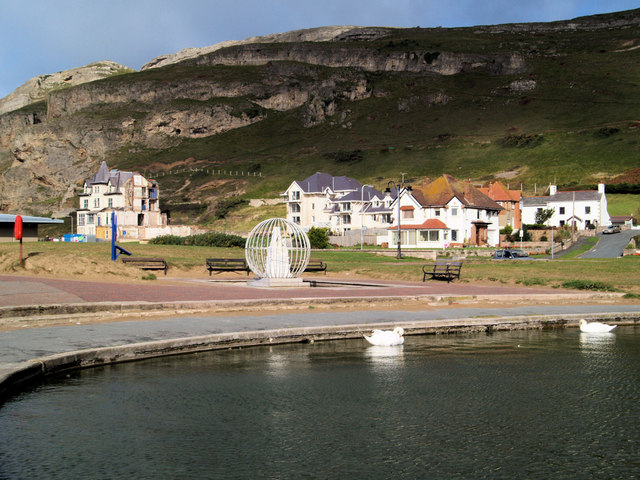
West Shore is the natural starting point for any visit focused on the Alice connection. The White Rabbit statue stands here, close to the bay where Penmorfa once stood. The site of Penmorfa itself (LL30 2QY) is now undeveloped land; there is no building to visit, but the view — across the bay toward the Conwy estuary, with the Great Orme behind — is much as Alice would have known it. The two rocks known as the Walrus and the Carpenter can be seen from the shore at low tide.
Around the town, five wooden carved character statues form part of the Finding Alice trail: Alice herself at the railway station, the Queen of Hearts near the promenade, the Hatter gazing up at the Great Orme, the Cheshire Cat at West Shore near the former Penmorfa site, and Tweedledee and Tweedledum in Haulfre Gardens. The full trail covers 34 points of interest and is self-guided, free, and accessible year-round.
What Researchers Still Need to Find
One of the things that makes Llandudno's Alice story genuinely interesting — rather than just a polished tourism narrative — is how much remains unknown. Honest engagement with the open questions is more useful to visitors and historians than false certainty.
The most important unanswered question is the location of the photograph album Carroll gave to Alice. Photographic analysis of the figure "almost certainly" identified as Carroll by the Llandudno and Colwyn Bay History Society has never been formally published. If the album is held in a known collection — it was eventually sold by Alice's family — expert attribution could settle the Carroll visit question definitively.
Carroll's surviving diaries are held at the British Library. Scholars have worked through them, but a specific search for post-1862 entries mentioning the Liddells being at Llandudno has not been comprehensively published. The British Newspaper Archive is another potentially rich source: Victorian social columns regularly reported who was staying where at fashionable resorts, and a systematic search for "Liddell Llandudno" might find a definitive mention of Carroll accompanying the family.
The 1933 White Rabbit unveiling generated local newspaper coverage, and the full text of Alice's letter — beyond the quoted passage — and the complete coverage in the North Wales Pioneer archive would add to the historical record. Similarly, the tradition of naming the West Shore rocks after the Walrus and the Carpenter deserves scrutiny: is there any Victorian evidence for the local name, or did it emerge in the 20th century? And Prince Leopold's 1873 Llandudno visit — what was his reason for coming, and what did local newspapers report about it?
Karoline Leach's 1999 book In the Shadow of the Dreamchild is the key scholarly source on the Carroll/Liddell relationship and should be the starting point for anyone who wants to understand the more complex history behind the popular story. No tourism website appears yet to have engaged seriously with her findings.
 Day trips